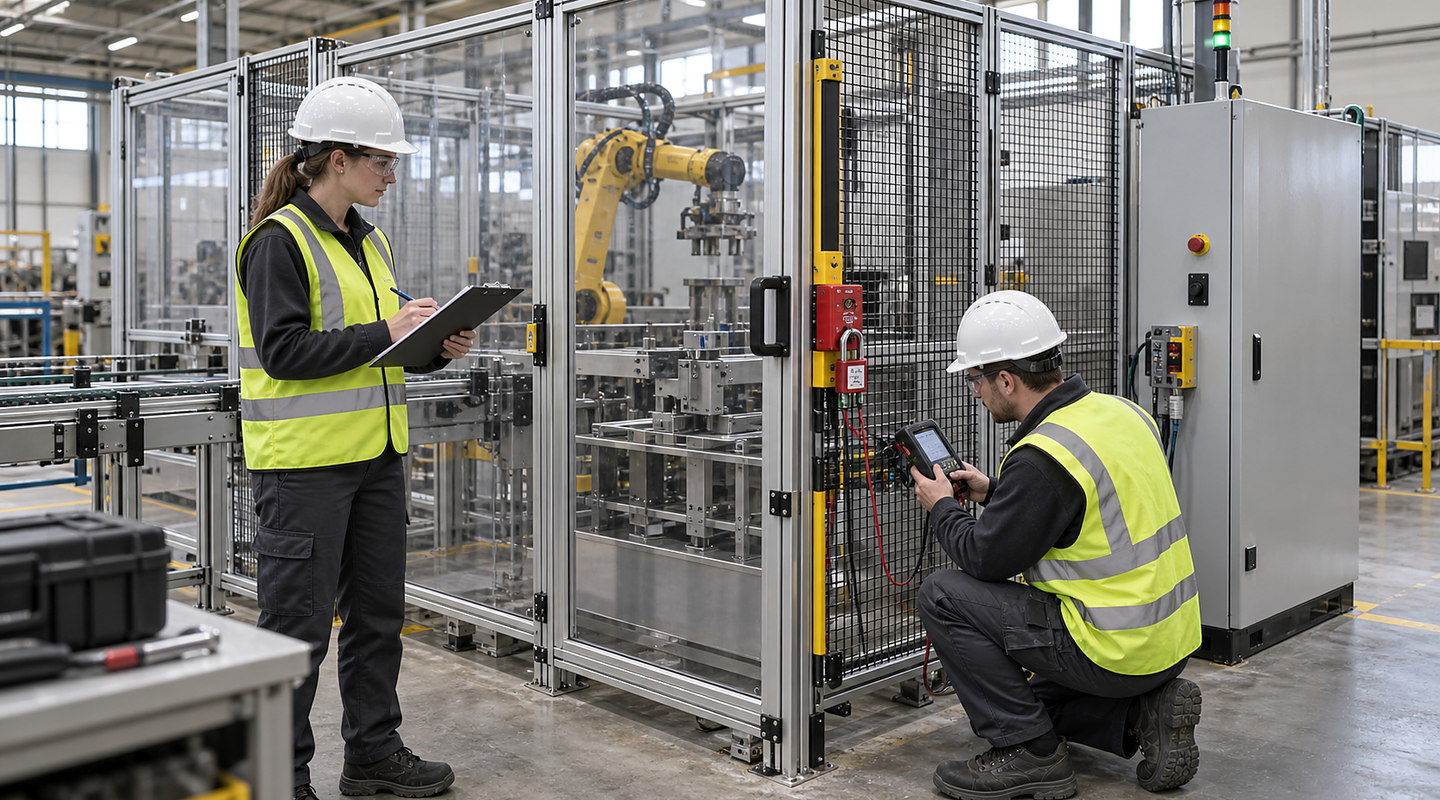
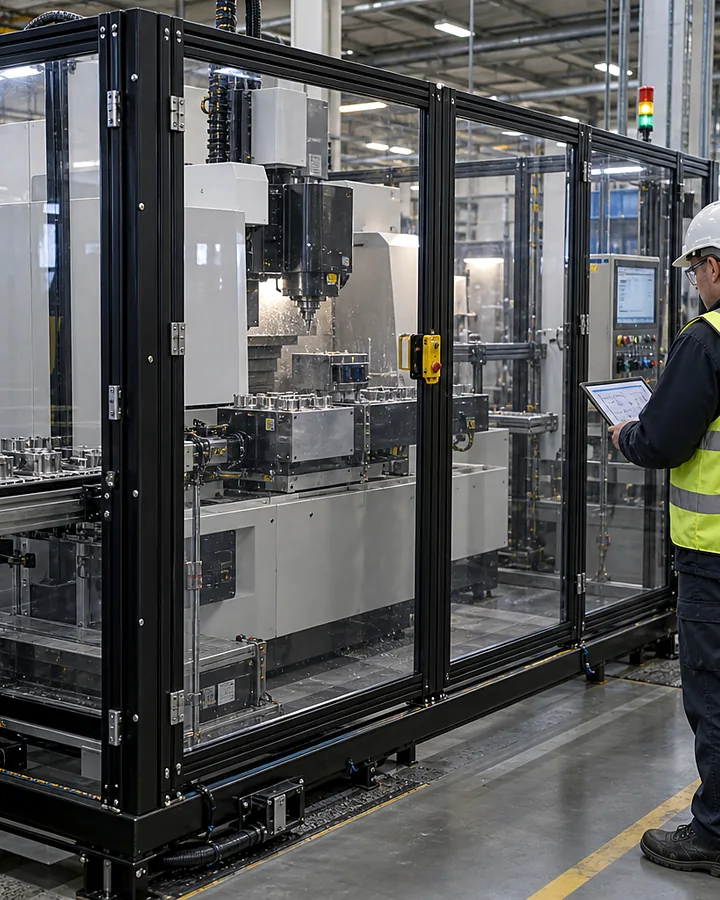
Safeguarding Existing Machinery for Emergency-Stop System Upgrades
Plan safeguarding existing machinery for emergency-stop system upgrades around the actual machine, operator tasks, access needs and stopping behaviour, line connections, operating limits, acceptance checks and next steps.
In brief
For safeguarding existing machinery for emergency-stop system upgrades, start with the actual machine, operator tasks, access needs and stopping behaviour and your full operating sequence, then check normal production, intervention, fault and restart scenarios before committing to a final layout.
Plan emergency stop retrofits around your machine hazards, operator tasks, access, stopping behaviour and validation evidence. Discuss a site-specific safeguarding concept with Oxford Machine Guarding.
On the production floor
Plan for the conditions your team handles every day — Emergency Stop Retrofits
Plan emergency stop retrofits around your machine hazards, operator tasks, access, stopping behaviour and validation evidence. Discuss a site-specific safeguarding concept with Oxford Machine Guarding. For safeguarding existing machinery for emergency-stop system upgrades, the deciding details include hazards and foreseeable access for emergency-stop system upgrades, operating, cleaning and maintenance tasks and risk-reduction and validation evidence.
Details worth resolving early for safeguarding existing machinery for emergency-stop system upgrades
Question 1
Hazards and Foreseeable Access for Emergency-Stop System Upgrades
For safeguarding existing machinery for emergency-stop system upgrades, describe the current position, required outcome, acceptable limits and known exceptions for hazards and foreseeable access for emergency-stop system upgrades. That lets us compare options against your real production rather than one nominal value.
Question 2
Machine Motion and Stopping Behaviour
For safeguarding existing machinery for emergency-stop system upgrades, describe the current position, required outcome, acceptable limits and known exceptions for machine motion and stopping behaviour. That lets us compare options against your real production rather than one nominal value.
Question 3
Operating, Cleaning and Maintenance Tasks
For safeguarding existing machinery for emergency-stop system upgrades, describe the current position, required outcome, acceptable limits and known exceptions for operating, cleaning and maintenance tasks. That lets us compare options against your real production rather than one nominal value.
Question 4
Existing Control-System Architecture
For safeguarding existing machinery for emergency-stop system upgrades, describe the current position, required outcome, acceptable limits and known exceptions for existing control-system architecture. That lets us compare options against your real production rather than one nominal value.
Question 5
Space, Visibility and Operator Ergonomics
For safeguarding existing machinery for emergency-stop system upgrades, describe the current position, required outcome, acceptable limits and known exceptions for space, visibility and operator ergonomics. That lets us compare options against your real production rather than one nominal value.
Question 6
Risk-Reduction and Validation Evidence
For safeguarding existing machinery for emergency-stop system upgrades, describe the current position, required outcome, acceptable limits and known exceptions for risk-reduction and validation evidence. That lets us compare options against your real production rather than one nominal value.
Your operating cycle
Plan for more than automatic running
Include replenishment, normal production, planned change, short stops, fault recovery, cleaning and maintenance for safeguarding existing machinery for emergency-stop system upgrades. A fast automatic step can still leave your team with a slow or awkward overall process.
Normal production and variant changes
Replenishment and material presentation
Operator access and safe interventions
Cleaning, maintenance and recovery
Prove the result
Test safeguarding existing machinery for emergency-stop system upgrades against real operating, access, stopping and recovery scenarios
Normal production
Run the agreed product or part mix for safeguarding existing machinery for emergency-stop system upgrades at your intended operating pattern.
Difficult conditions
Include credible extremes for hazards and foreseeable access for emergency-stop system upgrades and machine motion and stopping behaviour.
Fault and recovery
Show how the proposed solution detects a problem affecting safeguarding existing machinery for emergency-stop system upgrades, responds safely, informs your team and restarts under control.
Important limits
Be clear about what the trial has shown
A site survey and task-based risk assessment are required before a safeguard is selected.
Mechanical changes can affect access, visibility, cleaning and machine operation.
A component or guard alone does not establish compliance of the complete machine.